
St. Joseph City Directory Shelves
The local collection is much larger than one famous volume. Its strongest routes are the Indiana State Library guide, the St. Joseph County Public Library Local & Family History room, the History Museum's Bendix Research Library, and a small number of scans. The table separates the collection, dates, custodian, and access so a missing web result is not mistaken for a missing book.
| Collection | Years | Where held | Access |
|---|---|---|---|
| South Bend and Mishawaka runs | 1899/1900 through 2015, with gaps | State Library, SJCPL, History Museum | Guide, shelves, microfilm and some scans |
| William L. Farr directory | 1883; Notre Dame also holds 1886–87 | Internet Archive and Notre Dame Archives | Free 1883 scan; archive access for holdings |
| History Museum directories | Collection described from 1867 to present | Vincent Bendix Research Library | Appointment and reading-room research |
| Obituary index | Primarily Tribune, beginning 1913 | SJCPL | Online index; full item onsite or with staff |
| Sanborn maps | Local access spans 1867–1970; editions vary | SJCPL and State Library | Library database and map collection |
| SBAGS indexes | Marriage 1832–2013; wills 1830–1971; other spans vary | SBAGS and County Archives | Use index, then request the original record |
The State Library guide warns that its 1971–2005 entries do not include Mishawaka. That warning matters. A South Bend-only gap cannot be filled by treating the county or its two cities as one publication area.
St. Joseph Directory Publishers
Publishers and titles changed. Chas. B. Hibbard & Co. issued the 1899–1900 county directory. Directory South Bend Co. produced South Bend and Mishawaka books in 1901 and 1903, followed by 1905 and 1906 volumes that also named rural route lists. Hibbard runs appear again in 1908, 1910, 1912, 1914, 1916, and 1919.
Polk volumes dominate much of the later run. Listed years include 1920, 1921, 1923, 1925 through 1932 with some limits, 1935, 1941, many postwar editions, and later books through 2005. Polk returned in 2013 and 2015 for South Bend and Mishawaka listings. The 1929 volume is incomplete and begins at page 314. Publication gaps must stay visible in a research timeline.
| 1882–1887 | Early South Bend material, including Farr's 1883 scan and Notre Dame's 1886–87 holding |
|---|---|
| 1899–1919 | County, South Bend, Mishawaka, rural-route, Directory South Bend, and Hibbard eras |
| 1920–1941 | Polk run with gaps and an incomplete 1929 volume |
| 1945–2005 | Later Polk and telephone-style South Bend material, with listed gaps |
| 2013–2015 | South Bend and Mishawaka Polk listings |
Read a St. Joseph Directory Entry
The digitized 1883 William L. Farr volume gives a page-level model. Its abbreviations include agt for agent, bds for boards, lab for labor, manufr for manufacturer, propr for proprietor, res for residence, and r r for railroad. Always inspect that edition's key rather than applying a code learned from another book.
| Name | The listed person or business, with initials and spelling preserved as printed |
|---|---|
| Trade or affiliation | A role, employer, shop, plant, railroad, institution, or professional office |
| Residence | The address following res.; this is not a deed or ownership mark |
| Household clue | Spouse, widow, boards, or shared address when the edition includes it |
| Street clue | Directional letters, corner, opposite, avenue, addition, or street-section reference |
For example, the book identifies Everett L. Abbott as water works superintendent at a South Michigan residence. It also ties H. H. Miller to Studebaker's and a South William address, while Minnie Muessel is listed as a widow on North Hill. These are dated directory statements. OCR can be wrong, so compare the scan before normalizing a name or number.
- Criss-cross directory
- An address-first section arranged by street and house number. Not every volume has one.
- Householder index
- A name list centered on a household head or principal listed resident, not every person present.
- Abbreviation key
- The edition's code list, often near the front, needed to interpret trades, streets, residence, and boarding marks.
St. Joseph Rural Directory Clues
The History Museum's 1898 example shows how much a short line can hold: Smith, John fr 40 A jd w Susan P.O. North Liberty. Museum interpretation identifies a farmer, 40 acres, joint deed with Susan, and the North Liberty post office. That is more than a name hit. It joins family, land, work, and postal geography in one compact entry.
The 1898 and 1899 books broadened their scope toward county residents and rural routes. At the time, a post office label could be the best practical location clue even when a modern street address did not exist. Compare the route or post office with township, deed, census, and map evidence. Do not turn an old postal label into a present municipal boundary.
Note: Preserve the printed abbreviation and the expanded interpretation together, since later researchers may need to test a different reading against the page.
St. Joseph Directory Research Desks
The SJCPL Local & Family History room is on the third floor of Main Library at 304 S. Main Street in South Bend. Research librarians provide help with directories, newspapers, yearbooks, church records, clippings, databases, and microfilm. FamilySearch Affiliate access and library databases add sources that may not be available from home.
A narrow long-distance request can ask for an obituary, marriage clue, newspaper item, or directory page. The query form requests a name, place, question, date range, and contact details. Outside-county research is listed at $10 per hour with a $5 minimum, usually within one to four weeks. An exact date range and spelling variants give staff a practical search target.
The History Museum's Vincent Bendix Research Library at 808 W. Washington is open Monday through Friday, 10 a.m. to noon and 1 to 5 p.m., with appointments recommended. It holds maps, deeds, blueprints, photographs, newspapers, oral histories, business papers, and ethnic and African American collections. Its online selection is only a small part of the holdings.
St. Joseph Digital History Companions
Directories become stronger when paired with sources that supply a date and relationship. The SJCPL obituary index is primarily based on Tribune material and begins in 1913. It includes name-oriented searching plus address, city, state, decade, and notes concepts. Full records generally require an onsite or staff-assisted step.
Notre Dame announced searchable South Bend Tribune coverage from 1873 through 2018. SJCPL also points to Chronicling America, Hoosier State Chronicles, Newspapers.com, and its own newspaper resources. Michiana Memory contributes photographs, maps, postcards, architecture, newspapers, and yearbooks. A news name hit still needs the city directory year, exact address, or another matching fact.
The library's digital tools are useful, but a JavaScript gateway or search index does not mean the original is online. Record the item title, collection, date, and call information, then ask the holding institution for the image or source record.
South Bend Records Change Context
Old directories often name city offices, wards, public works, and institutions. Modern municipal files help explain those references without acting as a resident list. South Bend's City Clerk keeps legislation, minutes, notices, oaths, and official city records. The official City Clerk page was captured for this project.
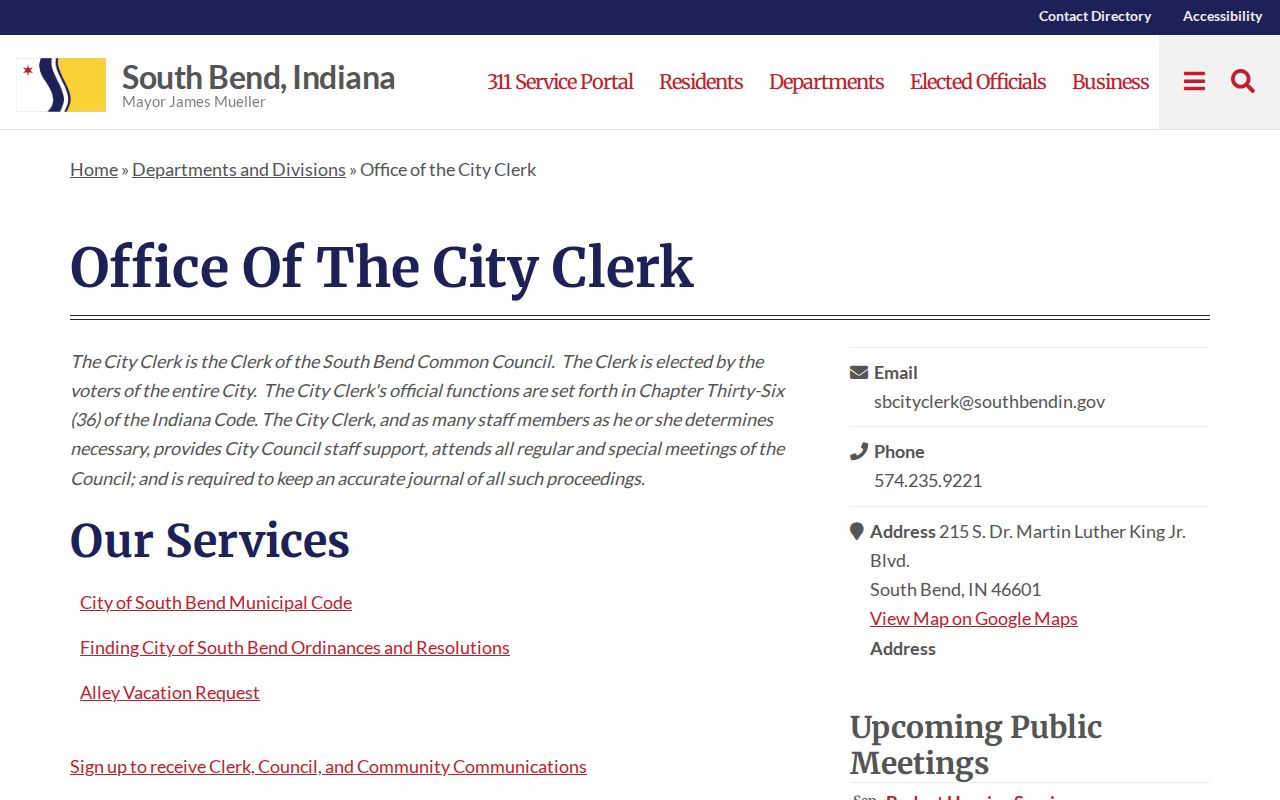
The page identifies the municipal custodian. A person may appear as an official, applicant, witness, or meeting participant, but there is no promised citywide person index.
South Bend's current service center is separate from county property and court offices. The new City Hall information shows the present city-services destination.
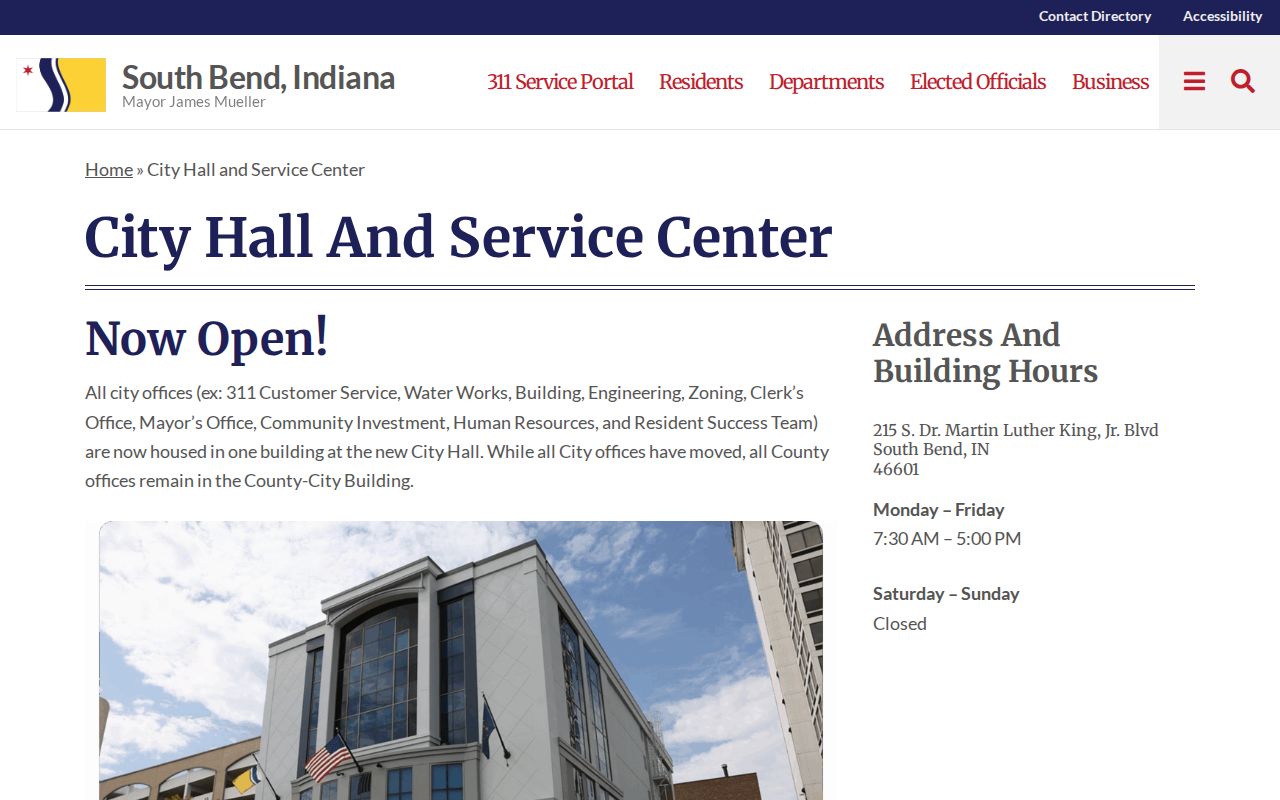
This current location helps avoid following an obsolete office address printed in an old directory or archived document.
Trace St. Joseph Families by Directory
A St. Joseph County city directory can fill the years between federal census releases. Use it as a dated waypoint, not as proof that the same person remained at one address for a full year. Common names require at least one added match, such as a spouse, occupation, employer, obituary, age, legal description, or dated family event.
- Find the surname and likely address in one known year. Preserve the publisher, page, city scope, and exact spelling.
- Read the abbreviation key, then note the residence, trade, employer, spouse, widow mark, boarding status, or rural route.
- Move to the next available year in both directions. Record moves, removals, initial changes, and publication gaps rather than smoothing them over.
- Use the street section only if that volume truly has address-first material. Compare nearby listings when a house number or road name may have changed.
- Pair the directory sequence with the 1850–1950 public censuses, then test the trail with an obituary, newspaper, vital index, parcel, deed, or probate file.
If a person vanishes, several explanations remain possible: a move, death, publication omission, unlisted status, spelling change, boundary shift, or a volume that does not cover Mishawaka or the rural area. The evidence should state which years were actually checked.
St. Joseph Directory Gaps
Coverage is uneven by year, publisher, place, format, and access. The run has a 1917–1918 gap, the 1929 Polk volume is incomplete, and much later material is held on shelves or microfilm. The directory collection does not guarantee a distinct reverse or criss-cross section in every year. SJCPL staff report that later microfilm can be uncataloged, making an advance question useful.
Street renumbering is another risk. Research confirmed errata, removals, rural-route sections, and changing address forms, but did not locate an official South Bend or Mishawaka renumbering schedule. Bridge an uncertain number with intersections, neighbors, legal lot and subdivision, parcel geometry, Sanborn block numbers, and the directory street index.
A historical listing can support family history, reconnection, estate research, and house history. For a modern address-keyed parcel and deed path, use the St. Joseph County street directory. Keep the two tasks separate so an old listed resident is never presented as a current occupant.