
Start a St. Joseph County Residents Directory Search
A name usually belongs in XSoft Engage, MyCase, the library obituary index, or a historical directory. An address belongs first in the Assessor portal and county GIS. A date or family event may point instead to a directory volume, marriage index, probate file, obituary, or vital-record custodian. Each source was created for a different public task, so agreement across two records is much more useful than a lone match.
Official rolls identify owners, registered voters, parties to cases, license holders, or people named in instruments. They do not form a full household roster. A mailing address may not be the parcel address, an owner may live elsewhere, and a missing online result can reflect closed data, old books, retention, or a portal gap.
- Search XSoft Engage by owner, address, or property number and save the parcel ID.
- Use Indiana Voters for an individual registration and polling-place check.
- Follow the parcel or party name into Recorder land-record systems.
- For an older trail, consult SJCPL directories, newspapers, census sources, and indexes.
- Ask the correct custodian for a specific record when the public portal stops.
Where St. Joseph County Keeps Resident Records
The Assessor maintains current assessment cards; the Recorder keeps deeds, mortgages, liens, plats, easements, and related land instruments; and Elections manages registration services. The Auditor and Plat Room track transfers, parcel changes, and plats. The Clerk and courts hold case and marriage or divorce material, while the Archives & Records Center helps with older indexes and files. Address-first research continues in the St. Joseph County street directory.
St. Joseph County Recorder
227 W. Jefferson Blvd., Room 321
South Bend, IN 46601
Weekdays, 8:00 a.m. to 4:30 p.m.
St. Joseph County Assessor
County-City Building
South Bend, IN 46601
Owner, address, and property-number routes
County Elections and Voter Registration
Individual registration services
St. Joseph County, Indiana
Protected records remain confidential
Use the St. Joseph County Parcel as the Bridge
The most reliable bridge between a name and an address is often the parcel identifier, not the street number alone. XSoft separates the situs address, owner mailing line, legal description, parcel number, assessment neighborhood, and transfer history. Those fields answer different questions. The situs describes the assessed location; the mailing line tells where a tax notice goes; the legal description identifies the land.
Begin by copying the result as it appears, including punctuation in the parcel number and abbreviations in the legal description. Then compare the map popup and the assessment card before following a transfer date into Recorder records. This keeps similarly named streets and owners from being merged. It also preserves a clear source trail if the portal changes after an annual assessment update.
| XSoft field | Best use in a directory search | Important limit |
|---|---|---|
| Owner | Find the assessed owner name | Does not list every occupant |
| Address | Open a parcel from its situs | Normalize street terms if needed |
| Property Number | Connect assessment, GIS, and deeds | Copy the number exactly |
| Transfer History | Find dates for deed follow-up | Assessment data is not a title opinion |
| Legal Description | Check lot, block, or subdivision identity | It is not a postal address |
The inspected parcel card also carried valuation, taxes, land, improvements, sketch, documents, and neighborhood tabs. Some tabs can be blank. Treat the card as an assessment snapshot and verify ownership history through recorded instruments.
One inspected New Carlisle card illustrates the range without turning a sample into a rule. It displayed a situs and mailing line, Olive Township, a taxing district, a school corporation, a platted-lot description, transfer dates, and neighborhood amenities. The sales tab showed no sale in that view even though transfer history contained dates. That difference is why each tab must be described precisely. A blank sale list does not cancel a transfer entry, and neither field proves who was physically present in the home.
St. Joseph County Property Images and Deed Clues
The free XSoft assessment search is the practical first stop for a current parcel. Its result gives the identifier needed to move into GIS, tax history, and Recorder searching.
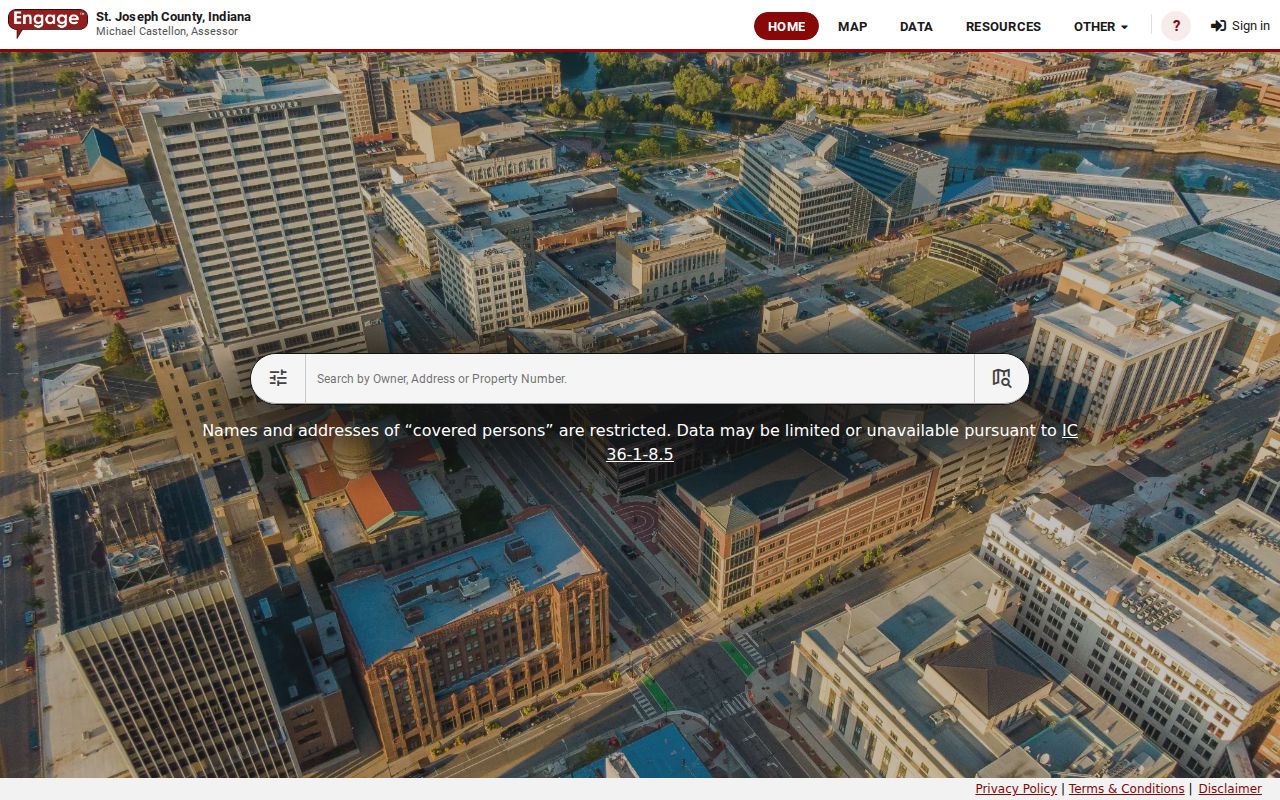
This portal view belongs at the start of the chain because a parcel number can survive spelling, abbreviation, and mailing-address differences.
The Recorder's Laredo land-record system adds party names, instrument types, legal descriptions, and document references to that parcel trail.
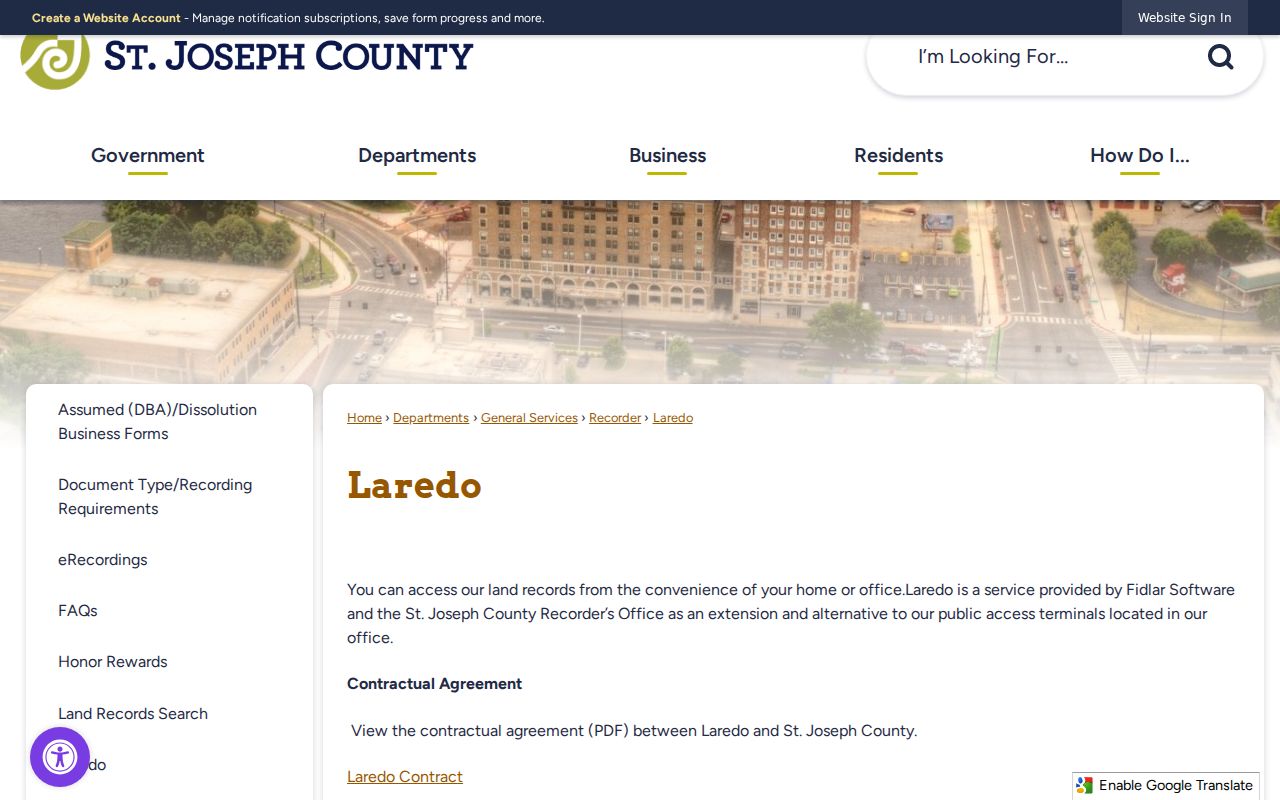
Published coverage needs care: the current landing page says January 1992, while an official 2018 agreement described a January 1977 start. Confirm the live cutoff before relying on either date.
Current St. Joseph County Residents Directory Sources
No current source lists everyone. Instead, the St. Joseph County residents directory is assembled from official indexes whose entries reflect ownership, registration, litigation, custody, licensing, or a recorded transaction. Start with the record family that fits the question and keep its legal and practical limits attached to the result.
| Source | Who It Lists | Keeper | Access |
|---|---|---|---|
| XSoft parcel roll | Assessed owners | County Assessor | Free portal |
| Indiana Voters | Individual registration records | State and county elections offices | Free official lookup |
| Recorder index | Parties to land instruments | County Recorder | Limited free and paid routes |
| Indiana MyCase | Parties in public Odyssey cases | Indiana Judicial Branch | Free search |
| PLA verification | State-licensed professionals | Indiana Professional Licensing Agency | Free verification |
The same name across a parcel card, docket, or filing does not automatically identify the same person. Dates, middle names, addresses, case details, and parcel numbers help separate matches. The one-person method is developed on the St. Joseph County resident lookup page.
Court Names Are Case Relationships, Not Resident Rolls
Indiana MyCase searches public Odyssey cases by name, case number, or attorney information. Name controls can include a sounds-like option, date of birth, court, status, and filing range. Results may show a case number, court, caption, status, filing date, parties, charges or claims, and docket events, depending on public access.
Sealed, confidential, expunged, adoption, some older, and non-Odyssey material will not appear. A no-match result therefore does not prove no court record exists. The St. Joseph County Clerk is the fallback for certified copies and court-held material, while federal cases use PACER for the Northern District of Indiana.
Docket: the dated list of filings and events in a case. An index entry is a pointer; a certified copy comes from the custodian.
Vital Records Split Across St. Joseph County Custodians
Birth, death, marriage, and divorce records do not share one open name index. The county health department and Indiana Department of Health handle birth and death certificate routes. The Clerk issues marriage licenses and certified marriage records, while a divorce decree remains a court record. Archives, State Library guides, and local genealogy indexes help with older events.
Indiana birth certificates are restricted for 75 years, and certified death copies depend on eligibility, identity, and purpose. Adoption records are confidential; qualifying people use Indiana's Adoption Matching Registry. These controls are part of the record, not obstacles that a residents directory can bypass.
Registration Checks and Protected St. Joseph County Addresses
Indiana Voters provides official registration, polling-place, ballot, and absentee tools. A computerized voter-file request follows a separate VRG-24 process with strict limits on solicitation and redistribution. Full Social Security numbers, Address Confidentiality Program records, agency declinations, and proof-of-citizenship documents remain confidential or redacted.
The Indiana voter portal is useful for a person's own status and election details, but its live interface returned an access block during research.
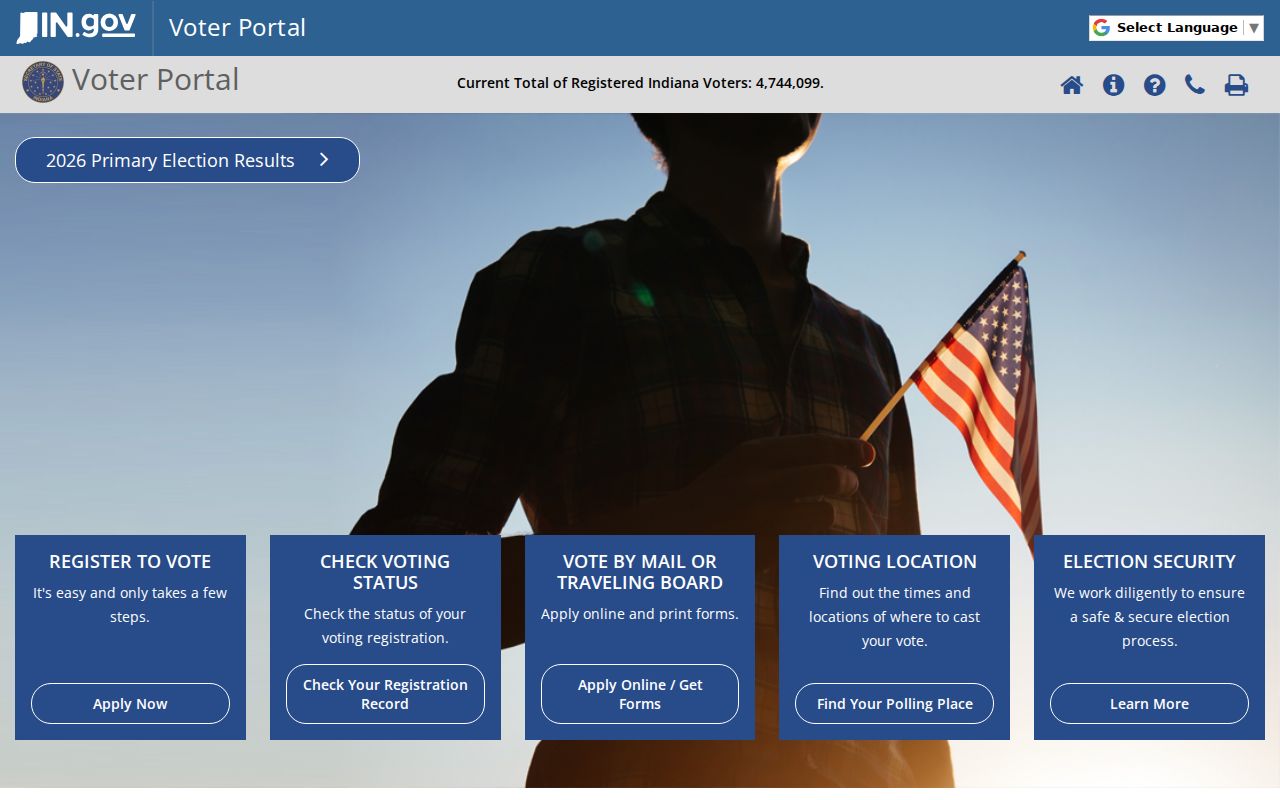
The image confirms the official route, while the documented access gap is a reason to retry the state service or contact county Elections rather than infer a negative result.
Official Rolls Compared With Broad Search Tools
Official records are narrower but easier to interpret because a named office explains why each entry exists. A parcel card concerns assessment. A deed concerns a recorded land transaction. A court result concerns litigation. A business filing concerns an entity relationship. Broad commercial tools may combine many sources, but their update dates, match logic, and correction paths can be unclear.
Official source
Known custodian, stated record purpose, record-specific fields, and a direct route for copies or correction.
Compiled source
Convenient discovery lead, but identity matches and freshness require confirmation against the underlying custodian.
Lawful use. Use St. Joseph County records for legitimate personal research, and never to stalk, harass, intimidate, or harm another person.
South Bend and County Records Now Use Different Desks
City and county geography matters. South Bend moved city public-record and service functions to the City Hall and Service Center at 215 S. Dr. Martin Luther King Jr. Boulevard during 2025 and 2026, while county property and court work remains at the County-City Building. An old directory entry may therefore point to the wrong present-day counter.
St. Joseph County also includes Mishawaka, seven towns, thirteen townships, and unincorporated communities. Postal labels, township lines, municipal boundaries, ZIP areas, and taxing districts overlap without becoming the same geography. Identify both the record type and governing office before making a request.
The mismatch is useful evidence when handled carefully. A mailing city can help deliver a letter while a township controls assessment geography and a municipality keeps a code case. County GIS layers can show parcels, annexations, city or town boundaries, townships, subdivisions, voting precincts, zoning, and rights-of-way. Those layers explain why two records use different place labels, but they do not identify household members. Save the layer name and map date with any conclusion.
Historical St. Joseph County Residents Directory Shelves
The Indiana State Library guide identifies South Bend directories from 1882, an 1883 digitized volume, an 1886 to 1887 Farr edition, and substantial runs from 1899 or 1900 through 2015 with gaps. Mishawaka has its own runs, including 1901 through 1969; the guide warns that 1971 through 2005 volumes do not cover Mishawaka. Never fill that gap with a South Bend-only book.
SJCPL's Local & Family History area brings together directories, newspapers, microfilm, databases, obituary searching, FamilySearch Affiliate access, and a narrow staff lookup service. The History Museum, State Library, SBAGS indexes, Notre Dame newspaper archive, census sources, and Recorder books add other dates and record types. A directory entry can show a name, address, role, spouse, business, or removal note, but each abbreviation and volume boundary must be read on its own terms.
The SJCPL Local and Family History collection is the local gateway for this older residents directory trail.
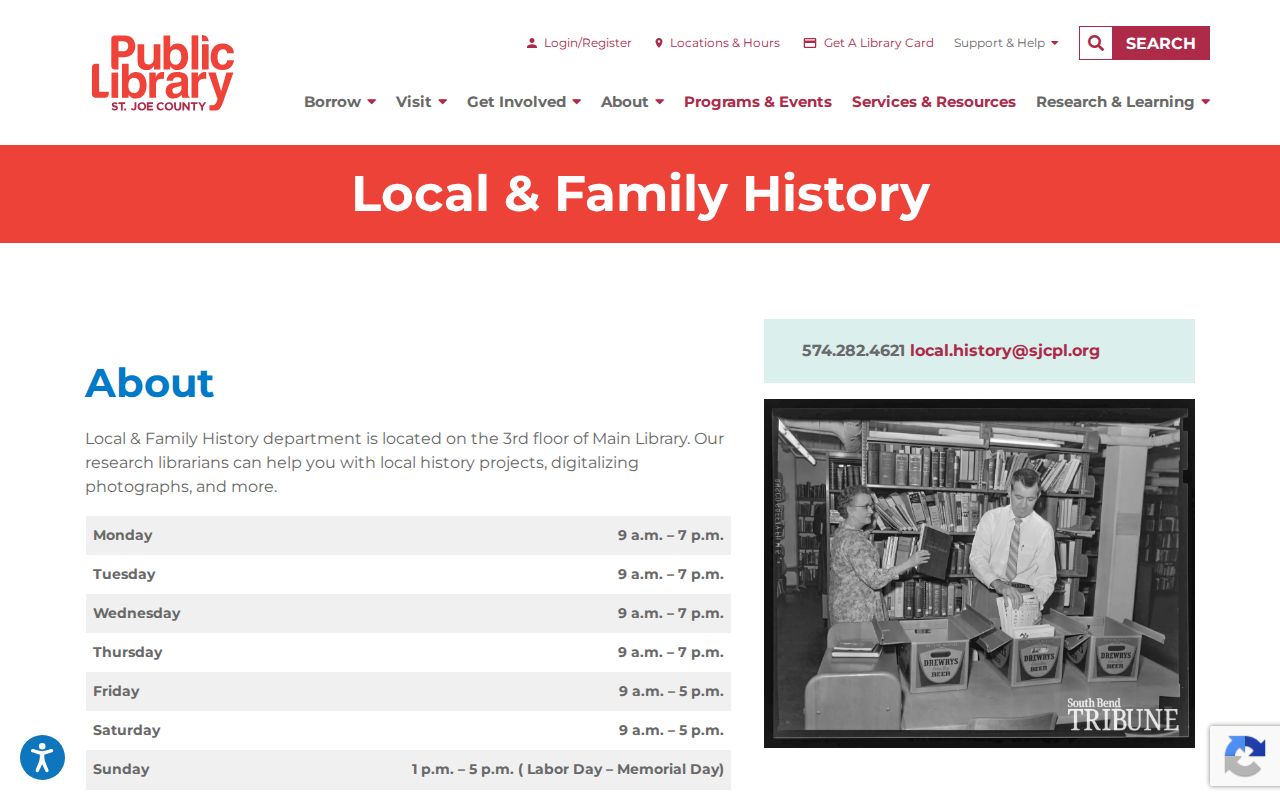
This collection image connects the modern search to the physical and digital shelves where directory years, obituary clues, newspapers, and family-history sources can be checked together.
When a St. Joseph County Portal Has No Result
A narrow Indiana Access to Public Records Act request can reach records that are public but not indexed online. IC 5-14-3 asks for reasonable particularity, so name the department, record type, address, date range, case number, parcel, or instrument when known. Inspection is free. A request made in person or orally is acknowledged within 24 hours; a written request sent by mail, fax, or email is acknowledged within seven days, though production may reasonably take longer.
Older work may require a Recorder terminal appointment, deed books, microfilm, Clerk files, Archives assistance, or an SJCPL lookup. County Archives holds many record groups dating to 1830, with series-specific spans. A web gap can also reflect confidentiality, an approved retention schedule, a dynamic interface, or material that has not been digitized.
Record vocabulary: a roll is maintained for an official purpose; an index points to a record; a parcel is mapped land; a criss-cross directory is arranged by address.