
Evidence in a St. Joseph Lookup
Choose the record that fits the question. The free county assessment card connects an owner name with a parcel, legal description, situs address, mailing line, and transfer history. Situs means the physical parcel address. It does not list every occupant. Indiana's voter tool confirms an individual's registration and polling information, while court, vital, probate, business, and license records document separate public events or roles.
| Record | What It Confirms | Where | Access |
|---|---|---|---|
| Assessment | Recorded owner, parcel, mailing line, transfers | XSoft Engage | Free public portal, with protected fields withheld |
| Voter registration | Registration and polling information | IndianaVoters.gov | Individual lookup; full files have use limits |
| State court | Public party role, case number, status, and events | Indiana MyCase | Free summary; Clerk holds the official file |
| Family event | Birth, death, marriage, divorce, adoption route | Health Department, Clerk, Archives, IDOH | Indexes vary; certified copies may be restricted |
| Affiliation | Entity role or professional credential | INBiz and Indiana PLA | Free public verification |
Start with the source nearest to the fact already known. A property address points to XSoft. A case clue points to MyCase. A profession or license number belongs in the state licensing search. When the aim is to reconnect with family or a classmate, dated library and official family-record routes are safer than forcing a current address from an unrelated filing.
Separate Same-Name St. Joseph Residents
St. Joseph County had more than 272,000 residents in the 2020 Census, so a common name may produce many plausible records. Apply a two-clue test before treating a hit as a match. Compare the middle initial, suffix, spouse, approximate age, town, street, parcel number, license number, entity ID, or a dated event. Keep South Bend, Mishawaka, a township, and the postal city as separate fields because those labels can overlap without meaning the same jurisdiction.
Every result should also carry its date. An inactive business filing can prove that someone once held a role but not that the company still operates. A tax mailing address may belong to an owner who lives elsewhere. An obituary can identify relatives and a former address, but it cannot confirm a current home. Record what would disprove the match as well as what supports it.
Key check. A matching full name plus one dated address or unique record number is stronger than several undated name-only hits.
Search St. Joseph Court Names
Indiana MyCase searches public Odyssey cases from St. Joseph Circuit, Superior, and Probate Courts. Its Name tab accepts last, first, and middle names, a birth date, or a business name. A sounds-like control broadens spelling matches. Court, open or closed status, and filing-date ranges can narrow a crowded result set, which is capped at 1,000 results.
| MyCase Field | How It Helps | Format or Limit |
|---|---|---|
| Last / First / Middle | Build the name and test an initial separately | Trailing wildcard and sounds-like options |
| Birth Date | Separate people with the same name | Optional; not displayed in public results |
| Court / Status | Limit to St. Joseph and open or closed cases | Odyssey courts; All, Open, Closed |
| File Date | Match the case to a known period | From and To in mm/dd/yyyy |
A result card may show the case number, court, case type, filing date, status, parties, roles, attorneys, and a detail link. The chronological case summary, often called the CCS, may add hearings, events, disposition, charges, bond, or public documents. MyCase is still an index and summary, not the official record. Ask the St. Joseph County Clerk for an archived file or certified copy. Sealed, confidential, expunged, adoption, and some older cases will not appear.
Confirm a St. Joseph Resident
Verification means linking the name, place, and date without overstating any source. Use the narrowest official query available, save the record identifier, and then compare an independent custodian. If a portal returns no result, check spelling, former names, protected status, older office-only years, and technical outages before concluding that no record exists.
- Search XSoft by owner name. Save the parcel number, situs address, mailing line, township, legal description, and transfer date without treating the mailing line as residence.
- Check the individual Indiana voter lookup when appropriate. Registration or polling confirmation is a distinct dated clue, not an open street roster.
- Run MyCase with the surname, given name, middle initial, local court, and a useful date range. Note the party role and case number.
- Compare a family event, obituary, probate file, license number, or entity ID. Use two dated sources before calling the match current.
- Docket
- The court's list of filings and events in a case.
- Index versus image
- An index points to a record; an image shows the scanned document and may require separate access.
- Certified copy
- A custodian-issued copy bearing official proof that it matches the record held by the office.
Find Family Through St. Joseph Records
Family searches have purpose-built local routes. An heir or fiduciary can begin with a Probate Court cause number or the Archives and SBAGS estate and will indexes, then compare public docket events, deed transfers, marriage clues, and obituaries. Confidential financial schedules may remain closed even when an estate index is public. The SJCPL obituary index begins in 1913 and can point to relatives, former addresses, churches, groups, and funeral details.
The SJCPL Local and Family History staff accepts narrow obituary, marriage, newspaper, or directory lookup requests with a defined date range. That human-assisted route is valuable when spelling changed or an online system stops at a recent year. A former classmate search can use school yearbooks, newspaper collections, and historical directories, with the school and year kept beside the name.
Birth relatives require special care. Indiana adoption records are confidential. Eligible adult adoptees, parents, siblings, and qualifying relatives should use the IDOH Adoption Matching Registry, its consent and nonrelease process, or a confidential intermediary. An ordinary public search must never be used to defeat that protected route.
Confirm St. Joseph Affiliations
Business and license searches help distinguish people, but neither proves where a person lives. INBiz accepts business name, ID, filing number, registered agent, or incorporator and governing-person searches. Its advanced fields include entity type, status, street, city, and ZIP. Preserve the entity ID and filing date because an old address or inactive entity only describes the filing at that time.
The Indiana Professional Licensing Agency search provides real-time original-source verification by profession, first or middle name, last name, license type, city, state, county, ZIP, license number, status, or doing-business-as name. Public output may include a name, license number, address, issue and expiration dates, and status. Home phone, email, Social Security numbers, and exam data are excluded or protected.
The official professional-license interface below shows why the search should key on license number and status, then treat geography only as a supporting clue. The MyLicense verification search is the source.
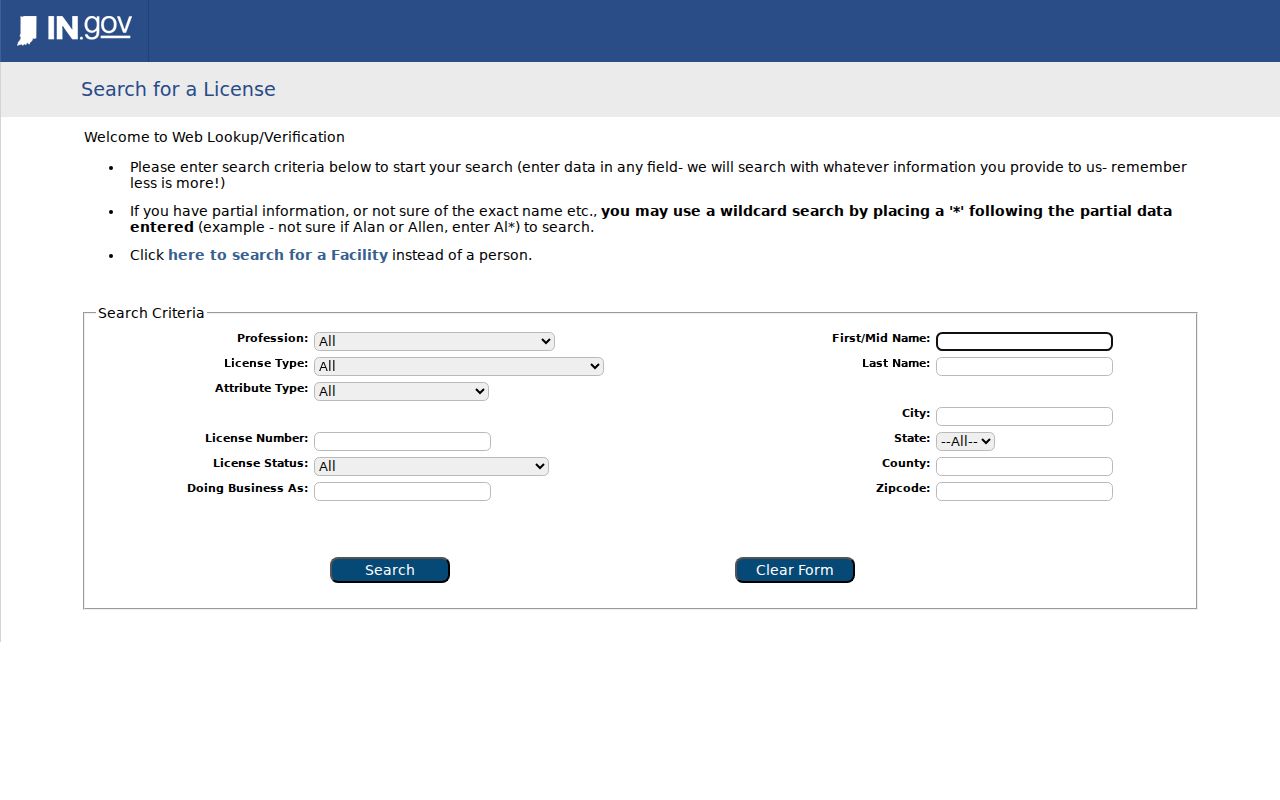
The form's person and facility modes keep credential verification separate from assumptions about a private home address.
Check Current St. Joseph Custody
Custody databases answer a narrow status question. The county jail roster, Indiana Department of Correction locator, federal Bureau of Prisons locator, and offender registry are separate systems. A missing result is not proof that no history exists because custody may change, a portal may be unavailable, or the person may fall outside that system. Save the search date and identifier.
The Indiana DOC Offender Locator accepts a last name, first name, or DOC number. Its captured interface is useful for understanding the official route.
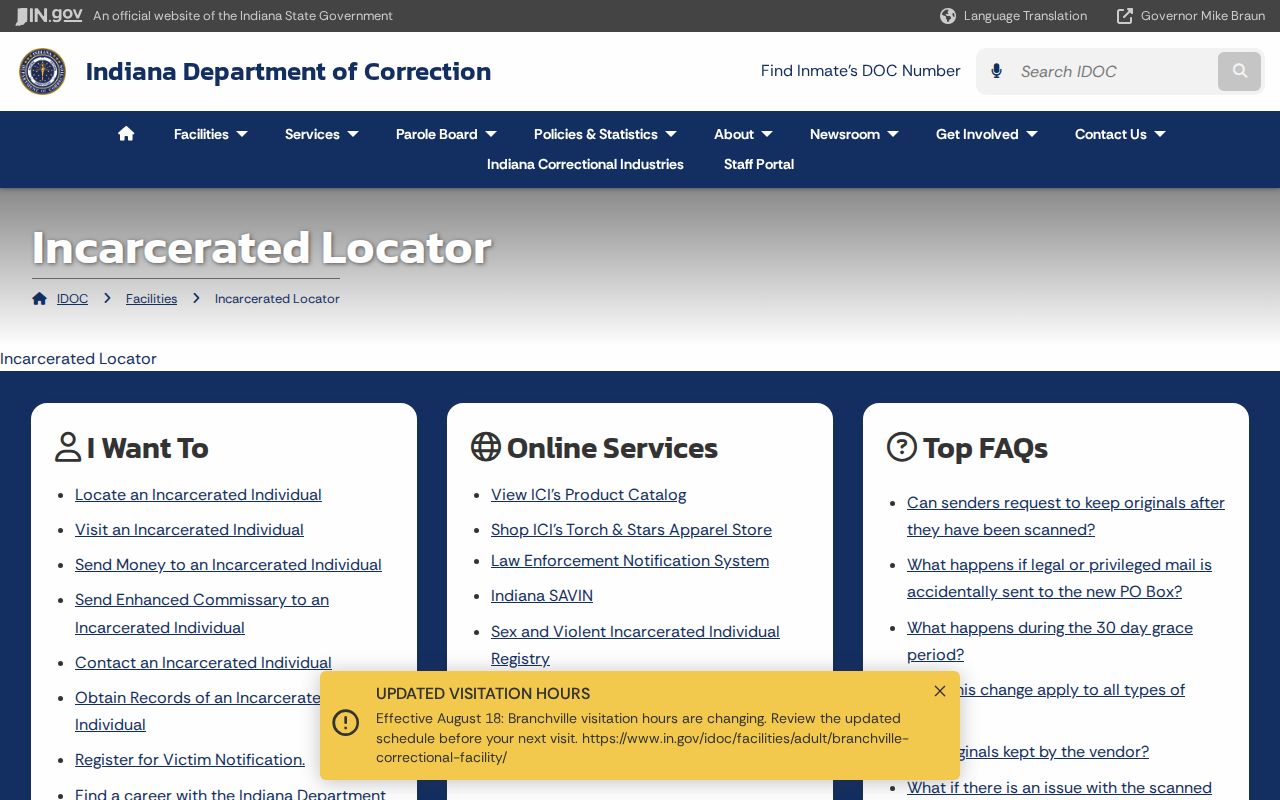
This state locator should be read as current system data, not as a complete biography or a substitute for the underlying court record.
Protect Privacy in Resident Lookups
Indiana law keeps some people and fields out of ordinary searches. The Address Confidentiality Program provides qualifying survivors with a substitute address for state and local services. Protected voter data, full Social Security numbers, adoption records, sealed filings, and specified motor-vehicle information are also restricted. A hidden result may show that privacy rules work; it must not trigger an attempt to infer the address from another roll.
Indiana's Consumer Data Protection Act gives qualifying consumers rights involving private-company data, including access, correction, deletion, portability, and certain opt-outs. Those rights do not erase an accurate deed, docket, voter record, or archival directory that a public custodian must keep. Correct an error with the office responsible for that field: Assessor or Auditor for a parcel, Recorder for an index, Elections for registration, Clerk for court material, IDOH for vital records, PLA for licenses, or INBiz for an entity.
When an office-only record is needed, send a narrow request under the Indiana Access to Public Records Act, IC 5-14-3. State the name, approximate date, record type, court or department, and known identifier. APRA requires access to existing public records; it does not require an agency to create a new list or reveal confidential material.
Keep the search log. Note the exact spelling, portal, filters, date, result number, and whether an address is physical, mailing, or historical. That short audit trail makes a correction easier and helps another family researcher reproduce the match without exposing extra personal data.
Lawful use. Use a St. Joseph County resident lookup only for lawful personal research, and never to stalk, harass, intimidate, or expose a protected person.